7 Critical Differences Between Peptides and SARMs
Peptides and SARMs are often sold side by side and discussed interchangeably, but they are fundamentally different classes of compounds. These 7 distinctions matter for every researcher.
1. Chemical Structure — Amino Acid Chains vs. Small Molecules
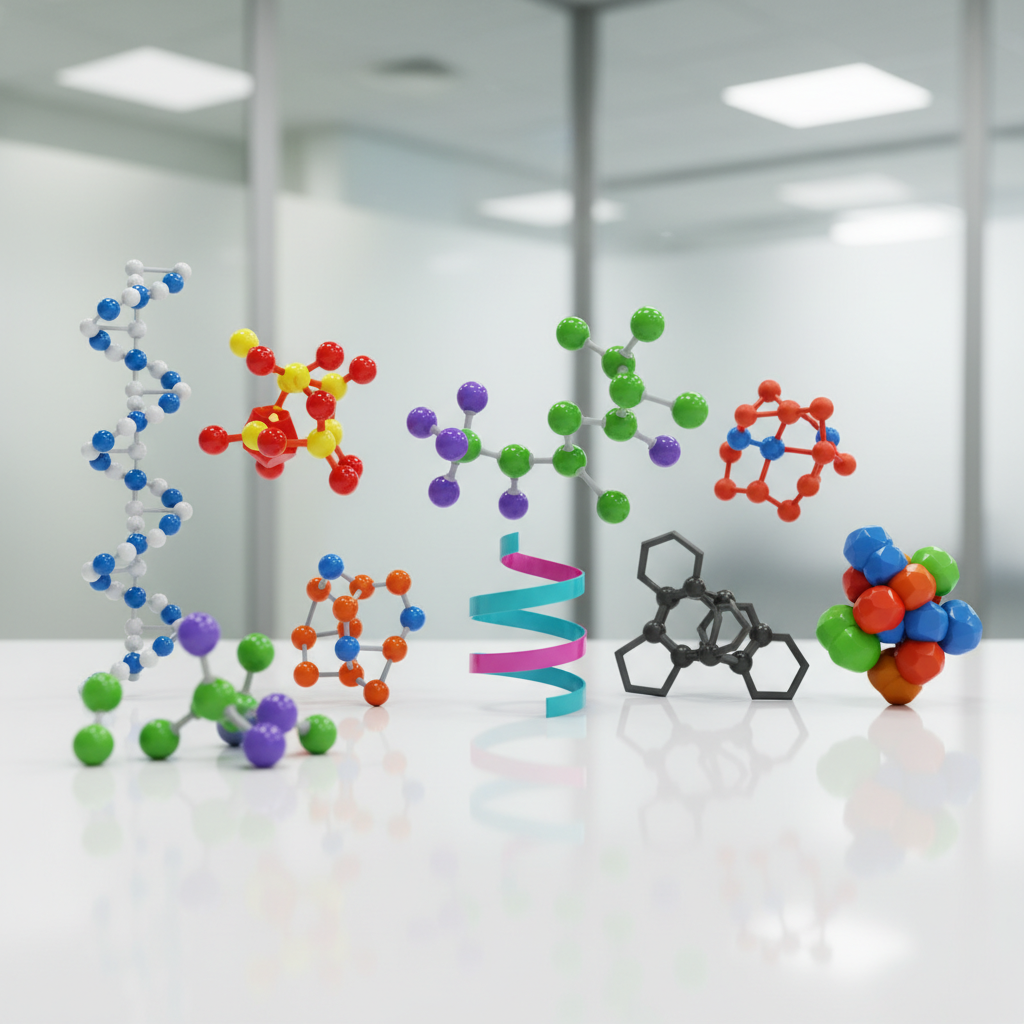
The most fundamental difference between peptides and SARMs is structural. Peptides are chains of amino acids linked by peptide bonds — they are biological molecules built from the same building blocks as proteins. They range from short sequences (2-3 amino acids for dipeptides and tripeptides) to longer chains of 40+ amino acids. Their structure is dictated by their amino acid sequence, and they adopt three-dimensional conformations (secondary and tertiary structure) that determine their biological activity. SARMs (Selective Androgen Receptor Modulators) are small organic molecules — not amino acid-based, not protein-derived. They are synthetic chemical compounds designed through medicinal chemistry to bind selectively to androgen receptors. Structurally, they are more similar to traditional pharmaceutical drugs than to biological molecules. This structural difference has profound implications for synthesis, stability, delivery, mechanism of action, and metabolism. Conflating peptides and SARMs because they appear in the same vendor catalogs is like conflating antibiotics and vaccines because they are both found in pharmacies — they are fundamentally different classes of compounds that happen to share a distribution channel.
2. Mechanism of Action — Diverse Receptor Systems vs. Androgen Receptor Selectivity
Peptides act through an enormous diversity of mechanisms. Different peptides interact with different receptor systems — growth hormone secretagogue receptors, melanocortin receptors, opioid receptors, neurotrophic factor receptors, and many others. Some peptides act as enzyme inhibitors, some as enzyme activators, some as gene expression modulators. The peptide universe encompasses hundreds of different compounds acting through dozens of distinct biological pathways. SARMs, by definition and design, act through a single receptor system — the androgen receptor (AR). They are engineered to activate the androgen receptor in a tissue-selective manner, producing anabolic effects in muscle and bone while minimizing androgenic effects in other tissues like the prostate. While different SARMs vary in their tissue selectivity profiles, they all converge on the same receptor system. This means SARMs research is fundamentally about androgen receptor biology, while peptide research spans virtually every major signaling system in mammalian biology. The breadth of peptide mechanisms versus the targeted focus of SARMs makes them complementary research tools rather than interchangeable ones.
3. Stability and Storage — Fragile Biologics vs. Stable Small Molecules
Peptides are inherently less stable than SARMs due to their biological nature. Peptide bonds are susceptible to hydrolysis (breakdown by water), peptides contain amino acid residues vulnerable to oxidation (methionine, cysteine, tryptophan) and deamidation (asparagine, glutamine), and larger peptides can unfold and aggregate. This instability requires careful storage — lyophilized storage at minus 20 degrees Celsius, protection from light and moisture, and once reconstituted, refrigeration with limited shelf life. SARMs, as synthetic small molecules, are dramatically more stable. Most SARMs are stable at room temperature for extended periods, resistant to hydrolysis and oxidation under normal storage conditions, and maintain potency in solution for much longer than reconstituted peptides. This stability difference has practical implications for research: SARM experiments are more forgiving of imperfect storage conditions, while peptide experiments require disciplined cold chain management throughout the handling process. Researchers transitioning from SARM-based to peptide-based research protocols need to upgrade their storage and handling practices accordingly.
4. Route of Administration in Research Models — Injectable vs. Oral
Most research peptides must be administered by injection in animal models because they are degraded by gastrointestinal enzymes (pepsin, trypsin, chymotrypsin) and have poor absorption across the intestinal epithelium due to their size and hydrophilicity. This limits their bioavailability to parenteral routes — subcutaneous, intraperitoneal, or intravenous injection depending on the experimental protocol. There are exceptions: some small, stable peptides like BPC-157 have been studied for oral activity, and intranasal administration is used for brain-targeting peptides like Selank and Semax. But injection remains the default route for most peptide research. Most SARMs, by contrast, are orally bioavailable — they survive gastric and intestinal conditions, absorb across the gut epithelium, and reach systemic circulation in active form after oral dosing. This oral bioavailability is a deliberate design feature, as SARMs were developed as potential oral pharmaceutical drugs. For research, oral dosing is operationally simpler than injection — it requires less technical skill, causes less animal stress in chronic studies, and is more practical for long-duration administration protocols.
5. Regulatory Status — Research Chemicals vs. Investigational Drugs
Both peptides and SARMs are commonly sold as research chemicals — not approved for human use, not dietary supplements, and labeled for research purposes only. However, their regulatory trajectories differ meaningfully. Several SARMs (including Ostarine/MK-2866 and LGD-4033/Ligandrol) have been or are currently in clinical trials as investigational new drugs, pursued by pharmaceutical companies for specific therapeutic indications. This means they exist in a regulatory space where they are simultaneously available as research chemicals and under active pharmaceutical development. Some peptides have similarly progressed through regulatory pathways (Tesamorelin has received FDA acknowledgment, several peptides are approved drugs in other countries), but the vast majority of research peptides have not entered formal pharmaceutical development pipelines. The regulatory distinction affects research in practical ways: SARMs under pharmaceutical development have more extensive published pharmacological data from clinical trials, while most research peptides rely primarily on preclinical and academic literature.
6. Quality Verification — Different Analytical Challenges
Verifying the quality of peptides and SARMs requires different analytical approaches, and understanding these differences helps researchers evaluate vendor quality documentation. Peptide identity is confirmed by mass spectrometry (matching observed molecular weight to theoretical), and purity is assessed by HPLC. The challenge specific to peptides is that impurities are often closely related compounds — deletion peptides, truncated sequences, oxidized variants — that can be difficult to resolve chromatographically from the target. A peptide COA's value depends heavily on whether the HPLC method is optimized to detect these closely related impurities. SARM identity and purity use similar analytical techniques (HPLC, MS, NMR) but face a different quality challenge: because SARMs are small molecules synthesized through organic chemistry rather than solid-phase peptide synthesis, the potential impurities are different — unreacted starting materials, synthetic intermediates, and isomeric byproducts. NMR (Nuclear Magnetic Resonance) spectroscopy is more commonly used for SARM characterization than for peptides because it provides detailed structural information that confirms not just molecular weight but precise molecular structure, including stereochemistry.
7. Research Community and Literature Base — Two Separate Worlds
Despite sharing vendor catalogs and online forums, peptide and SARM research exist in largely separate scientific communities with distinct literature bases, conferences, and research traditions. Peptide research is rooted in biochemistry, endocrinology, and pharmacology, with research published in journals like Peptides, Journal of Peptide Science, and Bioorganic and Medicinal Chemistry. The field has decades of foundational research dating to the isolation and characterization of endogenous peptide hormones. SARM research is rooted in medicinal chemistry and androgen receptor biology, with publications concentrated in journals like the Journal of Medicinal Chemistry, Endocrinology, and Molecular Pharmacology. The field is younger — SARMs were first described in the late 1990s — and the literature is more compact and focused. For researchers, this distinction matters because expertise in one field does not transfer directly to the other. A researcher with deep knowledge of peptide biochemistry may be unfamiliar with androgen receptor pharmacology, and vice versa. Treating peptides and SARMs as interchangeable research tools — rather than as distinct compound classes requiring distinct expertise — leads to poorly designed experiments and misinterpreted results.
Research Disclaimer: All information on this page is provided for educational and research purposes only. Products discussed are intended for laboratory research use exclusively. They are not intended for human consumption, therapeutic use, or as dietary supplements. Always follow institutional guidelines and consult published peer-reviewed literature for research protocol development. Not for human consumption.